What is the Impact of AI & Data Centres on the Environment?

Introduction: Environmental Challenges and Research Background of the AI Industry
The Environmental Cost of Fast AI Development
The AI industry is growing rapidly, changing our economy and daily lives in significant ways. But this growth comes with a serious environmental cost. Training and running AI systems takes huge amounts of electricity and water, and most people have no idea how much.
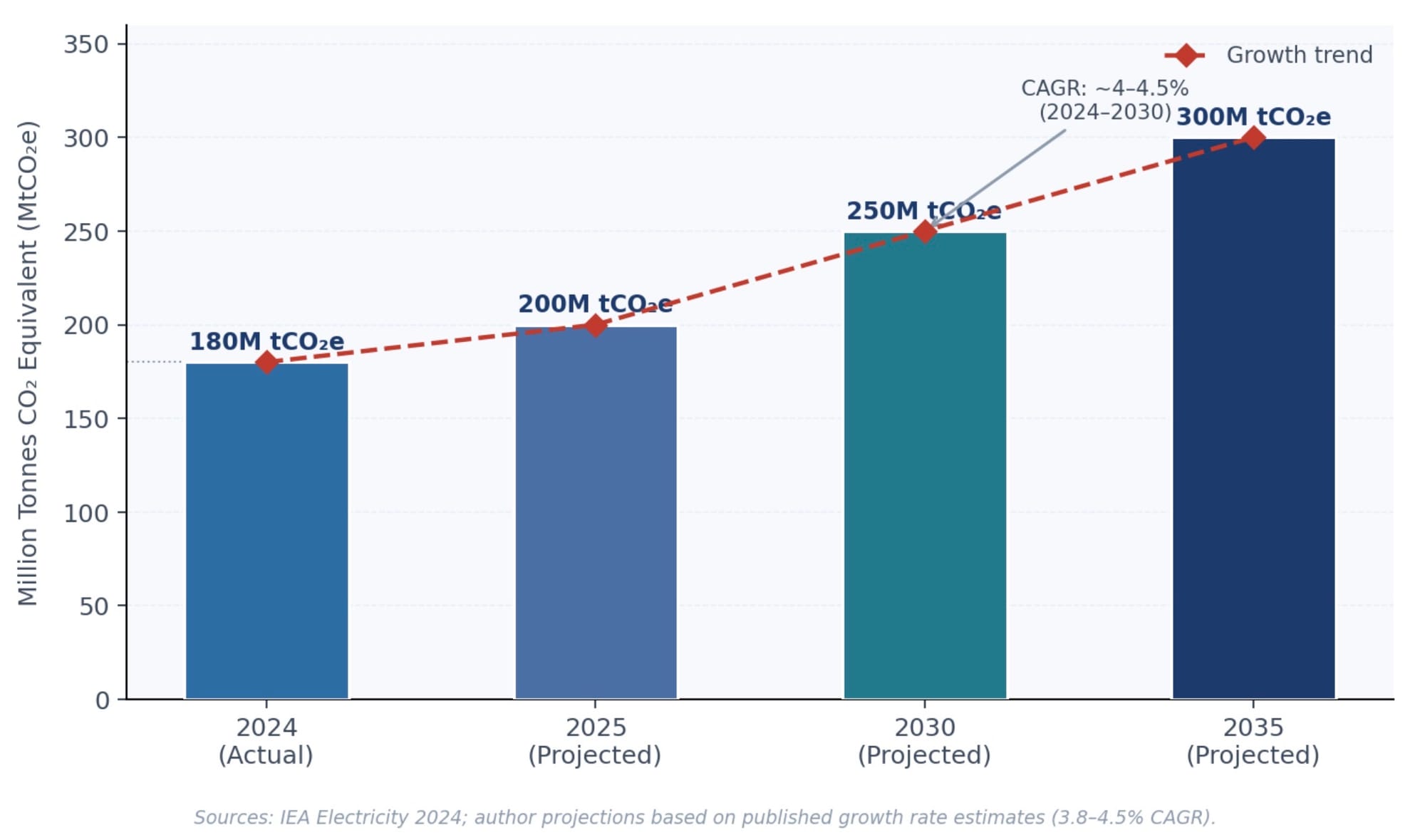
In 2024, data centres accounted for about 1.5% of global electricity consumption, or around 415 terawatt-hours (TWh). Experts say that by 2035, carbon emissions from data centres could grow from 180 million tons to 300 million tons. Water is also a big issue. Training just one AI model, like GPT-3, can use up to 700,000 litres of fresh water.
Research Scope and Analysis Framework
In this article, we look at how the AI industry affects both water and the climate. Instead of focusing on just one part, we follow the whole journey of AI — from making chips, to running data centres, to people using AI apps on their phones every day. This kind of full-picture approach is called a Life Cycle Assessment (LCA). We also use international standards such as ISO 14067 and the Water Footprint Network (WFN) framework to ensure our measurements are reliable.
We examine the environmental costs of AI through two lenses: water and carbon footprints. This includes monitoring everything from direct water use for cooling to total emissions over the life of a product. Because supply sources and regulations vary by region, our comparative analysis highlights these distinctions to guide the AI industry toward a more sustainable future.
Structure of the AI Industry and Environmental Impact Analysis
Parts of the AI Industry
Those numbers — 415 TWh of electricity, 700,000 litres of water to train one model — don’t come from a single place. They add up across a whole chain of steps: making chips, running data centres, training models, and finally, all of us using AI every day on our phones. To really understand why the numbers are so big, we need to follow that chain from beginning to end.
According to a 2025 report, the AI supply chain has five main parts. These include hardware (such as AI chips), cloud services, training data, basic models (such as GPT and Llama), and AI apps (such as ChatGPT).
To better understand the environment, we can group these into three stages. First is the upstream stage, which is about making chips. Second is the midstream stage, which focuses on running data centres, including cooling systems and power supply systems. Last is the downstream stage, where models are trained and used on our devices.
Key Environmental Problems
Looking at each part of the supply chain, we can see three main environmental problems. First, building chips uses a lot of energy and water. A modern factory can use up to 40 million litres of water every day — enough for around 300,000 households. The cleaning processes also require very pure water and can generate wastewater containing heavy metals. Second, the main issues at the data centre level are electricity and cooling water. For example, a 1-megawatt (MW) data centre's cooling system alone can use around 25.5 million litres of water per year. In 2024, Google’s data centres used 8.1 billion gallons of water, 28% more than the year before. Third, training large AI models uses huge amounts of power. For instance, GPT-3 used about 1,287 MWh of electricity. Carbon emissions also differ across models. GPT-3 produced about 588 tons of CO2, while the newer Llama 3.1 405B produced about 8,930 tons.
Water and Carbon Footprint Analysis of Chip Manufacturing
Water Consumption in Wafer Making
Wafer making is the most water-intensive step in chip production. Factories need huge amounts of Ultra-Pure Water (UPW) to wash silicon wafers, handle chemicals, and cool equipment. This water has to be thousands of times cleaner than tap water. To produce it, factories use methods such as reverse osmosis (RO).
To give a sense of scale, a typical chip factory uses more than 10,000 cubic meters of UPW every day. For example, Intel’s three advanced factories in Arizona use about 14 million gallons of water daily. Also, TSMC’s new factory in Arizona uses 4.75 million gallons a day, which is enough for 1.5 million families.
Why do they need so much water? Most of it is used for washing wafers and chemical cleaning. As chips become smaller (like 7nm or less), they need even more washing and better water quality. This makes the water problem even more serious. Also, there are big differences between regions. For instance, Samsung’s factories in South Korea use more than 300,000 tons of water per day.
Energy Use and Carbon Emissions in Chip Production
Chip production is also very energy-intensive. Most of the carbon footprint comes from two things: electricity and the production process. According to a report, the total CO2 footprint of chips made in 2021 was 500 million tons, and 21% came from manufacturing.
Data shows that 65% of emissions come from using electricity for machines and buildings. The EUV machines used to make advanced 7nm chips consume a shocking amount of power. In 2020, TSMC’s EUV machines consumed 10 billion kWh of electricity, accounting for more than half of its total power use.
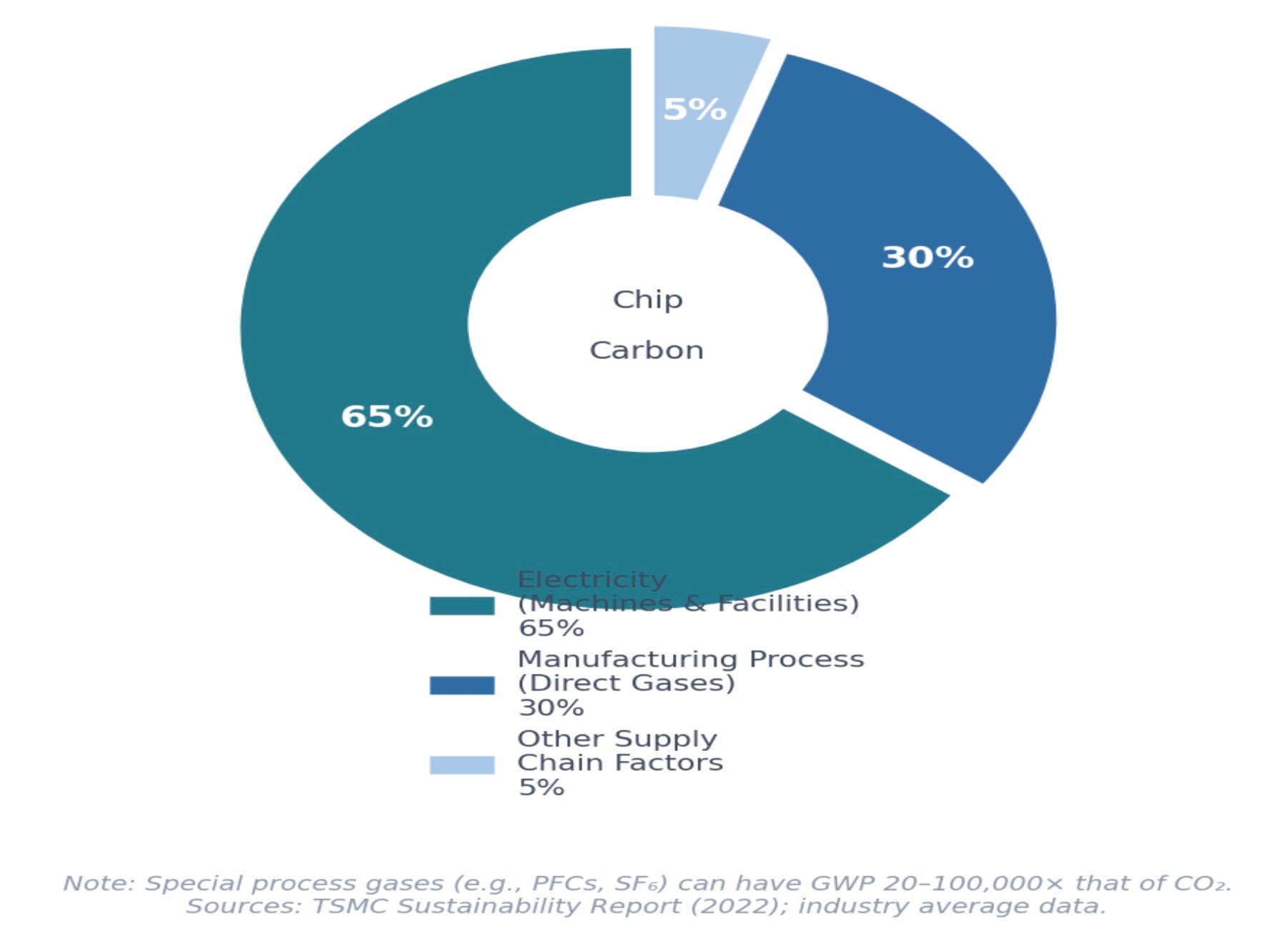
As chip technology moves to 3nm or 2nm, each chip uses even more energy. This is because the process becomes more complex. Besides, about 30% of emissions come from special gases used in the factory. These gases are very harmful to the environment; some are 20 to 100,000 times worse than CO2. Controlling these gases is the industry's biggest challenge.
Environmental Performance of Leading Manufacturers
Different chip companies around the world handle environmental problems in very different ways. How they care about water and carbon is a big deal for the future of AI. In fact, if these big makers don't manage their resources well, the whole industry will face serious trouble.
TSMC, the world's biggest chip factory, used 19.19 billion kWh of electricity in 2021. This was 7.2% of all the power sold in Taiwan, even more than the whole city of Taipei uses in a year! In 2022, only 10.4% of its energy came from green sources. However, its factories outside Taiwan have already started using 100% green energy.
In South Korea, Samsung Electronics uses a large amount of water—over 300,000 tons per day. They try to save water by using the "3R" method: reduce, reuse, and recycle. Also, the company is trying to use cleaner energy. In 2021, green sources provided 20.5% of their power. What's more, their factories in the US, China, and Europe are even better because they already use 100% green energy.
Intel has a plan to save more water than it uses by 2030. In 2024, it reached this goal in the US, India, Mexico, and Costa Rica. For its new factory in Arizona, Intel is working with the local government to build water treatment systems capable of treating 4 million gallons of water per day.
Finally, the local power grid matters a lot. In Taiwan, about 45% of power comes from burning coal. Because of this, a chip made in Taiwan produces much more carbon than one made in Norway, where they use water to generate power. In fact, a factory in Taiwan produces almost three times as much pollution as one in Oregon, USA.
That point about power grids doesn’t just apply to chip factories. It matters just as much for data centres, which run 24 hours a day and draw enormous amounts of electricity from whatever grid they are plugged into. In a way, data centres are even harder to manage than chip factories — a chip factory makes something and ships it out, but a data centre never stops running. Every extra second of AI use means more power drawn, more heat to deal with, and more water needed to keep things cool.
Environmental Impact of Running Data Centres
Energy Use and Power Usage Effectiveness (PUE) Analysis
Basically, data centres use energy for two main purposes: IT equipment, such as servers, and building systems, such as lighting and cooling. To measure how well a data centre uses electricity, experts use a metric called PUE (Power Usage Effectiveness). It is simply the total power used divided by the power used by the IT equipment. A score of 1.0 would be perfect; any number higher than that indicates wasted power on cooling and lighting.
In recent years, PUE scores worldwide have been improving. For example, we can see that some advanced data centres have reduced their PUE from 1.42 down to 1.30. Even better, Microsoft had an average score of 1.17 in 2024, and the best companies in the industry even got close to 1.1. All these changes show that new technology is playing a significant role in reducing energy consumption.
However, total power use is still growing very rapidly, which is a major concern. In 2024, data centres accounted for about 1.5% of global electricity consumption. In the US, business computers (especially AI systems) use 8% of electricity, and this could reach 20% by 2050. Microsoft’s power usage has even tripled since 2020!
The cooling system uses most of the building’s power. Old air-cooling systems use 30-40% of the total energy. But if we use new "liquid cooling" technology, this can drop to below 10%. In other words, liquid cooling can cut the total energy use in half.
Water Use and Water Usage Effectiveness (WUE) Optimisation
That liquid cooling has reduced electricity usage, so you use water through the system to remove heat. While better cooling reduces energy consumption, what happens to the rest, and how much of it is used up?
Data centres also need a lot of water to stay cool. They use water directly for cooling and indirectly when making electricity. A 1 MW data centre can use 25.5 million litres of water a year. That is the same as what 300,000 people drink in a day.
Big tech companies use a shocking amount of water. In 2023, Google used 24.2 billion litres, that's 1.7 Xihu West Lakes! If we add up all the water used by Google, Microsoft, and Meta, it would be enough for everyone in Shanghai (25 million people) to take a bath for 22 days.
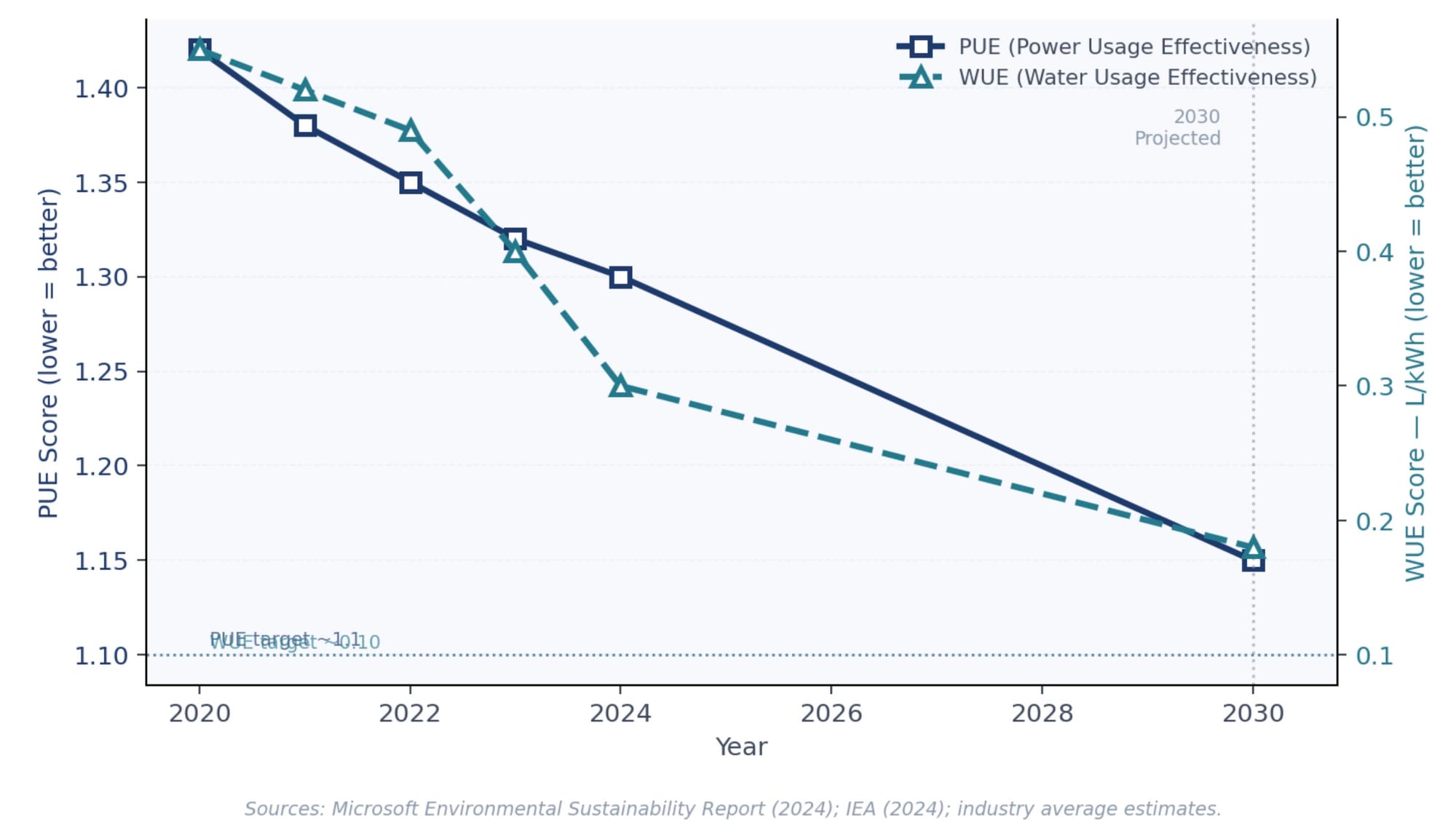
To monitor this, analysts use a comparable metric, the WUE (Water Usage Effectiveness). The lower the WUEA, the more efficient the centre is in water use. For example, Microsoft’s WUE in 2024 was 0.30 litres per kilowatt-hour (L/kWh).
Better technology is helping to save water. Old systems let water evaporate (turn into steam) to cool down, which wastes a lot of water. But new "closed" liquid cooling systems can cool chips without losing any water. These systems can save over 125 million litres of water per data centre each year.
Environmental Performance of Main Cloud Service Providers
Big cloud companies use different ways and set different goals to manage their data centres. How they perform directly affects whether the AI industry can grow sustainably.
Google reported in 2024 that its offices and data centres used about 31 billion litres of water. They want to use carbon-free energy all day and night by 2030. In 2024, their investment in clean energy helped reduce CO2 emissions by 8.2 million tons. However, in Iowa, Google’s data centre used 1.3 billion gallons of drinking water, as much as a whole university uses.
Microsoft has been working to save water since the early 2000s. Compared to their first data centres, they have improved water efficiency by 80%. Starting from August 2024, they launched a new design that uses "chip-level" cooling. This new way doesn't lose water through evaporation (water turning into steam). Their goal is to make water waste almost zero by 2030.
Amazon AWS runs one of the world's largest networks of data centres. They promised to use 100% green energy by 2025. But not everyone is happy. For example, in northern Spain, Amazon plans to build three new data centres. Local people are worried because these centres will use a large amount of their water each year.
Location and water stress are major issues for data centres. Since 2022, about two-thirds of new data centres in the US have been built in places that lack water. Right now, 437 data centres are being planned or built in dry states such as Nevada, Arizona, and California. These places are already facing serious water pressure.
All of that water pressure and energy demand doesn’t appear out of thin air. A big part of it comes from what is actually happening inside those data centres: training and running large AI models. To get a sense of the scale, training GPT-3 once uses roughly as much electricity as 100 average US homes consume in a full year. And as models keep getting bigger and more companies start building their own, these training runs are happening more frequently.
Environmental Impact of AI Training and Use
Energy Use in Training Large Models
Training big AI models is one of the most "power-hungry" parts of the industry. The carbon footprint here is much higher than for normal computer tasks. As models get larger, the cost of training them increases rapidly.
Energy in numbers: Training a GPT-3 model uses about 1,287 MWh of power. This is a huge amount. For example, training just one AI model produces 250 times more carbon than a regular American person does in a whole year.
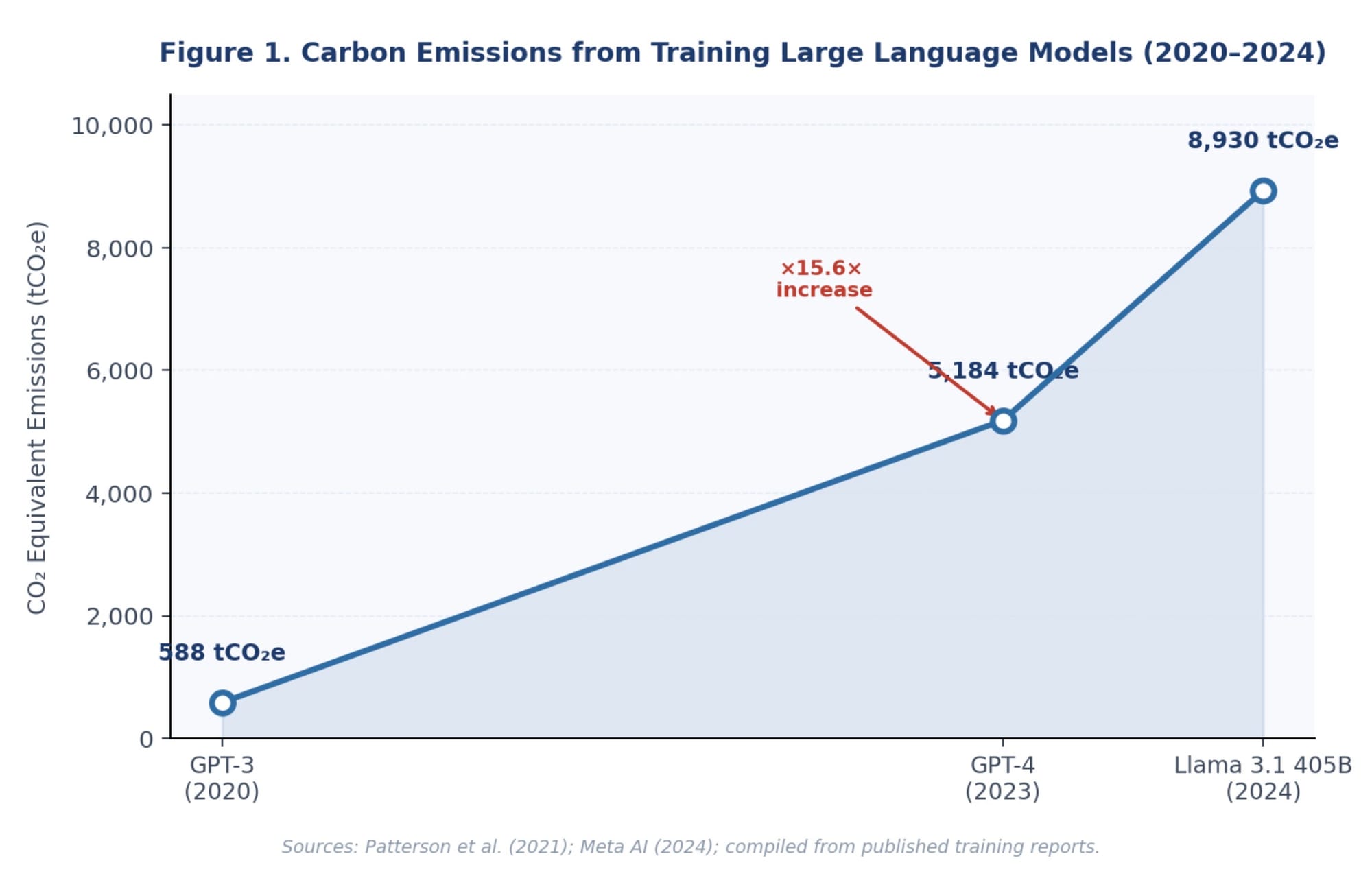
As AI models get better, they also produce more carbon much faster than before. For example, training GPT-3 back in 2020 released around 588 tons of CO2. But only three years later, the number for GPT-4 jumped to 5,184 tons. By 2024, a newer model, the Llama 3.1 405B, reached 8,930 tons. These numbers show us that the environmental cost of AI is growing at a shocking rate.
The machines matter because models are usually trained on many GPUs. A single A100 GPU uses about 400W of power, so a big group of them uses a lot of electricity. However, using better hardware or software can help. Research shows that some models use less power and work better just by choosing the right tools.
Environmental Impact of Using AI (Inference)
After training, people start using the model. This is called the inference stage. One question by itself uses very little power, but when you add up hundreds of millions of users asking questions every day, the total energy use becomes very large.
· Energy for one request: When GPT-3 makes 100 pages of content, it uses about 0.4 kWh of power. For a typical chat (a few hundred words), it uses about 0.004 kWh.
· The power of big numbers: Take ChatGPT as an example. If 100 million people use it and each person asks 10 questions a day, the total energy used is 4,000 MWh every day. Because there are so many AI services running at the same time, the total energy used for daily tasks is now almost as much as the energy used for training.
· Choosing the right place: Where and when we run these AI tasks also changes the environment. Because electricity in some places is "cleaner" than in others, moving AI tasks to different regions or different times of day can help reduce carbon emissions and save water.
Hidden Water and Carbon Footprint of AI Devices
AI runs on devices — smartphones, PCs, smart speakers, and more. Making and using these devices also costs a lot of water and adds to the carbon footprint. From mining raw materials to using the finished product, the environmental impact is much greater than most people realise.
· Making the devices: It takes a lot of water to build a smartphone. From sourcing raw materials to final assembly, one phone can leave a "water footprint" of thousands of litres. The most "thirsty" part is the chip inside, which requires just one processor to need hundreds of litres of very clean water.
· The cost of materials: sourcing rare metals for phones and computers puts a lot of pressure on our water resources. This process requires a lot of water to separate the metals and also produces dirty water contaminated with heavy metals. In fact, if people throw away old electronics, heavy metals like lead and mercury can leak into the soil and underground water.
· Energy use when we use them: Although one phone doesn't use much power, billions of devices together use a huge amount. In 2021, 63% of the carbon footprint of chips actually came from people using the devices. As AI becomes common in our phones, they will probably need even more power.
· Electronic waste (E-waste): Electronic waste (E-waste) is now one of the fastest-growing waste problems in the world. In 2023, people threw away over 60 million tons of e-waste, but only about 20% of it was recycled properly. What’s more, the plastic used in computers makes up about 20% of this waste. If we burn it, it releases very dangerous chemicals into the air.
We’ve now covered the full chain — chips, data centres, model training, and the devices in our hands. Taken together, the AI industry already produces around 500 to 600 million tons of carbon and uses 25 to 30 billion cubic meters of water every year. But these costs are not shared equally around the world. The same AI infrastructure can have a very different footprint depending on where it is built — a data centre powered by Norwegian hydropower produces a fraction of the emissions of one running on coal. Geography, energy policy, and local water supply all shape the extent of the damage.
Differences Between Regions and Their Impact
USA: Leading Technology but Facing Resource Pressure
As the leader in AI, the USA has the best technology, but it also faces big problems with water and energy.
· Large Scale: Data centres in the US are huge. In Virginia, there is a "Data Centre Alley" with at least 199 centres.
· Water Stress: About two-thirds of new data centres built since 2022 are in dry areas. For example, in states like Arizona and California, hundreds of data centres are being planned even though they lack water.
· Energy Transition: Google and other companies are trying to use clean energy. However, most of the US power grid still relies on coal and gas, so its carbon footprint remains high.
East Asia: Manufacturing Centre and Energy Challenges
East Asia (especially Taiwan, South Korea, and Mainland China) makes about 75% of the world's chips. The main challenge here is the significant energy and water requirements of factories.
· Mainland China: China's AI centres are usually smaller than those in the US. China is working hard to use "green power," and some advanced centres now use 80% clean energy.
· Taiwan: TSMC uses a lot of electricity—about 7.2% of Taiwan’s total. Since much of Taiwan's power comes from coal, making chips there produces more carbon than in other places.
· South Korea: Samsung uses over 300,000 tons of water every day. The carbon emissions from its chip industry also make a big contribution to the country’s total.
Europe: Policy and Green Development
Europe cares a lot about the environment. They use strict laws and green energy to grow their AI industry.
· Strict Rules: The EU requires data centres to report how much water they use. From 2025, new centres in cool areas must limit their water use.
· Green Energy: Countries like Norway and Sweden have lots of water power (hydro-power). This means chips and data services there have a very low carbon footprint.
Emerging Markets: Chances and Problems
Newer markets want to grow their digital economy, but they have limited resources.
· Water Crisis: In Latin America, 2024 was one of the hottest years. In Uruguay, people even protested against a new Google data centre because the country was facing its worst drought in 70 years.
· Hard Choices: Many data centres in China and India are in dry areas. These countries must find a balance between attracting AI investment and protecting their local environment. They should try to avoid the old path of "pollute first, clean up later."
Whether it’s in Arizona, Taiwan, or Uruguay, the pressure from AI infrastructure shows up in the same places in the end: rivers running lower, groundwater shrinking, local air getting worse, and global temperatures climbing. The regional picture shows who is carrying the heaviest load right now. But to fully understand what is at stake, we need to look at what the actual damage means on the ground — to the rivers and lakes people depend on, and to the climate we all share.
How AI Affects the Environment
Impact of Water Use on the Ecosystem
The AI industry uses water in many ways, harming the environment through direct use, pollution, and other forms of environmental damage.
· Breaking the Water Balance: Large data centres are changing the local water cycle. In dry areas of the US, data centres compete with farmers and city dwellers for water. For example, Google’s centre in Arizona uses 4 million gallons of water every day. Experts estimate that by 2028, the water used by US data centres could be four times what it is now.
· Affecting Rivers and Lakes: Chip factories and data centres take a lot of water from nearby rivers and lakes. This leaves less water for fish and plants. In Taiwan, this problem is very serious during dry seasons.
· Water Pollution: Making chips produces a lot of dirty water that contains heavy metals and dangerous chemicals. Even with good cleaning systems, the risk of pollution remains. In fact, back in 2024, most chip industry leaders warned that losing access to natural resources would be a major problem for their businesses.
Climate Effects of Greenhouse Gases
AI's carbon emissions are becoming a significant contributor to global climate change.
· Direct Emissions: In 2024, data centres released 180 million tons of carbon. By 2035, this could reach 300 million tons. Also, some special gases used to make chips are thousands of times worse for global warming than CO2.
· The Power Grid Problem: The "carbon cost" of AI depends on where the electricity comes from. For instance, a factory in Taiwan produces three times as much pollution as one in Oregon because Taiwan uses more coal to make power.
· AI as a Helper: On the bright side, AI can also help us study climate change and save energy. But we must make sure the energy AI saves is more than the energy it uses.
Problems with Materials and E-waste
From mining metals to throwing away old gadgets, the AI industry creates a chain of environmental problems.
· Mining Damage: To make AI hardware, we need "rare earth" metals. Mining these metals destroys forests and soil. It also uses a lot of water and produces toxic waste.
· Energy-hungry Materials: Making 1 kg of pure silicon for chips uses 1,500 kWh of power. However, if we recycle old silicon, we can save 60% of that energy. This shows why recycling is so important.
· E-waste Pollution: The world's electronic waste (E-waste) is growing by 2 million tons every year. If we don't handle it well, heavy metals like lead and mercury will leak into the ground and water. Also, burning the plastic in old computers releases very toxic air.
· Recycling Opportunities: The good news is that new technology can now recycle 90% of rare metals. This high efficiency gives us a better way to handle old equipment and protect our planet.
Ways to check the impact on nature
How to count water use
How do we know how much water AI uses? Usually, researchers have two main ways to check this. In the AI industry, we need to look at water use in two parts. First, there is "direct water," which is the water used on-site at the data centre or factory. Second, there is "indirect water." This means the water is used to make electricity or other things AI needs. To get the right number, we follow international standards such as ISO14046. We also compare different types of water, such as tap water and recycled water, to see which is better for making chips.
· Direct Water: This is the water used right at the data centre for cooling or in the factory for making chips. To calculate this, we use a formula that combines energy use, cooling efficiency, and the PUE score.

· Indirect Water: This includes the water used to make electricity and the water hidden in the supply chain. In short, it covers three areas: on-site water use, power plant water use, and chip-making water use.

· Standards: We follow the ISO14046 standard. We also compare the difference between using tap water and recycled water to see which is better for making chips.
Methods for Carbon Footprint
Measuring carbon is based on international rules, but we adjust them to fit AI technology.
·Rules and Standards: To make sure our results are fair, we mainly follow a famous international rule called ISO14067. This rule was built on older rules such as ISO14040 and ISO14044. Also, we look at other standards, such as the GHG Protocol and ISO14064. By following these rules, we can make sure that our study is consistent and can be compared with other research.
· How we calculate: A full study of carbon footprint follows a clear plan: first, we collect data, then we calculate, and finally, we check if the numbers are right. For AI training, we use a "whole life" method. This means we don't just look at the computer running; we start from getting raw materials at the very beginning and go all the way to when the AI model is ready to use. This way, we can see every bit of greenhouse gas it produces.
· Tools: There are special software tools like Code Carbon and Carbon Tracker. These can help us monitor how much power an AI model consumes in real time, providing the data we need to save energy.
Using Life Cycle Assessment (LCA) in AI
LCA is a powerful tool for understanding AI’s full environmental impact. It studies everything from the very beginning (mining) to the very end (waste).
· Steps: There are four steps: setting the goal, building a Life Cycle Inventory (LCI) of all inputs and outputs, running a Life Cycle Impact Assessment (LCIA), and then interpreting the results.
· Data: We build a database that includes water use, power use, and pollution from making chips and training models. This data comes from company reports and school research.
· Fixing Changes: AI changes very fast. To be sure about our results, we test how different technologies might change the final numbers. This helps us give better advice.
Giving the Environment a Price (Monetary Value)
Turning environmental damage into money helps bosses and leaders understand the "true cost" of AI.
· Damage Cost: We use economics to turn water loss or carbon emissions into dollar amounts. For example, the "Social Cost of Carbon" helps us see the economic harm caused by global warming.
· Full Cost Accounting: Businesses shouldn't just look at their bills; they should also think about the cost of nature. This helps them make better investment decisions.
· Return on Investment (ROI): We check if green technology (like water recycling or solar power) saves money in the long run. By comparing costs and benefits, we can prove that being green is also good for the pocket.
Future Trends and Ways to Grow Better
How Future Technology Changes the Environment
AI technology is changing very fast. This can be both a good and a bad thing for our planet.
· Models are getting bigger: AI models are growing at a shocking speed. For instance, Llama 3.1 is twice as big as GPT-3 in its parameters (size). Because of this, training these models requires much more electricity and produces more carbon emissions.
· Better ways to save energy: On the hardware side, new chips like NVIDIA H100 are 3 times better at saving power than old ones. On the software (app) side, new tricks like model compression (making it smaller) help AI use less energy when it works.
· New ways of computing: Things like Quantum Computing (super-fast physics computing) might change everything. Although it is still in the early days, it gives us hope that we can save energy in the long run.
How Rules Push the Industry to Change
Governments around the world are making stricter rules to make the AI industry "greener."
· Promises to be clean: Many big AI companies have promised to become carbon neutral — meaning their net carbon emissions will be zero — by 2030 or 2040. Google wants to use clean energy all day and night. Microsoft even wants to remove more carbon than it produces.
· Better laws: The EU is now putting environmental rules into its AI laws. In the US, some places are stopping people from building "thirsty" data centres in dry areas. China is also asking for low-carbon development.
· Paying for pollution: Carbon taxes, which charge companies for their emissions, are also becoming more common. These make it costly to keep using coal and gas, so companies have more reason to switch to cleaner energy.
Better chips, stricter rules, and company pledges are all heading in the right direction. But trends and promises don’t fix things on their own. The good news is that the tools are already there — liquid cooling, recycled water, green energy, and more efficient models. What the industry still lacks is a shared, coordinated plan to put them all into practice at scale. The following suggestions lay out what that could look like in concrete terms.
Suggestions for a Greener AI Industry
To build a better AI world, we need to work on technology, locations, and rules together.
· Better Technology: We should focus on AI that doesn't waste energy. We also need to develop Liquid Cooling (using water to cool chips) to make data centres more efficient.
· Better Locations: We should build big data centres in places that have lots of wind or solar power. Also, moving AI tasks to different areas can help us use clean energy better.
· Recycling System: We need to do a better job of recycling old electronics, especially for rare earth metals. Using recycled water in chip factories is also a great idea.
· Working Together: Governments, companies, and schools should work as a team. Governments set the rules, companies follow them, and schools provide the new technology.
· Global Cooperation: AI is a global thing, so countries should share their green technology. We need a global network to monitor the environment and alert us to any major problems.
Carbon Footprint: Total Amounts, Percentages, and Trends
Core Data (Base Year: 2024)
· Global Data Centre Emissions: In 2024, these centres released 180 million tons of CO2e, which constitutes about 0.3% to 0.4% of all greenhouse gases worldwide.
· Chip Life Cycle Emissions: In 2021, all chips produced 500 million tons of CO2e. Since AI chips make up about 30% to 40% of the market, the AI chip carbon footprint (the total gas produced) is about 150 to 200 million tons.
· Training Large Models (LLM): The carbon produced from training one model is growing very fast. For example, GPT-3 (2020) released 588 tons, but Llama 3.1 405B (2024) released 8,930 tons. In 2024, training all major models used about 100,000 to 150,000 tons of CO2e.
· Using Devices: In 2021, using devices (like phones and PCs) caused 63% of the total carbon emissions for chips. This means AI devices produce about 315 million tons of CO2e in a year.
Key Percentages and Structure
· Where Chip Carbon Comes From: 63% from people using them (usage), 21% from making them (factory), and 16% from the supply chain (materials).
· AI Energy Use: In 2024, data centres used 415 TWh of power, which is 1.5% of the world's electricity. In the US, business computers (including AI) use 8% of all business electricity.
· Sources in Chip Making: 65% comes from electricity for machines and buildings, 30% from the making process (direct gas), and 5% from other small parts.
Growth in Total Amounts(Trends for 2025-2030)
· Data Centres: Carbon emissions will reach about 200 million tons in 2025 and 250 million tons by 2030. The growth rate is about 3.8% to 4.5% every year.
· AI Chips: By 2030, the carbon footprint of AI chips will reach 360 to 450 million tons. This is because more and more chips will be used for AI.
· Model Training: As models get much bigger, training one model might release over 20,000 tons of CO2e by 2030. The total carbon for training will grow very quickly, about 40% to 45% each year.
Better Efficiency(Trends for 2025-2030)
· Lower PUE: The PUE score (energy efficiency) will drop from 1.30 in 2024 to about 1.15 in 2030. New liquid cooling will cut cooling energy use from 40% to less than 10%.
· Cleaner Chip Making: New technology (3nm and below) and green energy will help. Top companies want to use 50% to 70% green power by 2030. This will reduce carbon emissions from making chips by 30% to 35% for every dollar they earn.
Water Footprint: Total Amounts, Percentages, and Trends
Core Data (Base Year: 2024)
· Water for Chip Making: A modern chip factory can use 40 million litres of water every day. Total water used by big companies like TSMC, Samsung, and Intel is about 12 to 15 billion cubic meters per year.
· Water for Data Centres: A 1 MW data centre uses 25.5 million litres of cooling water a year. Globally, this adds up to about 8 to 10 billion cubic meters. Big companies use a lot: Google used 8.1 billion gallons in 2024 (up 28%). Google, Microsoft, and Meta together use about 1 to 1.2 billion cubic meters—enough for everyone in Shanghai to take baths for 22 days.
· Water for AI Training: Training one model like GPT-3 uses up 700,000 litres of fresh water. Every year, training all major models uses about 5 to 8 million cubic meters of water.
· Hidden Water in Devices: Making one AI smartphone uses about 2,000 to 3,000 litres of "hidden" water. With 1.3 to 1.4 billion phones sold a year, this totals 2.6 to 4.2 billion cubic meters.
Key Percentages and Structure
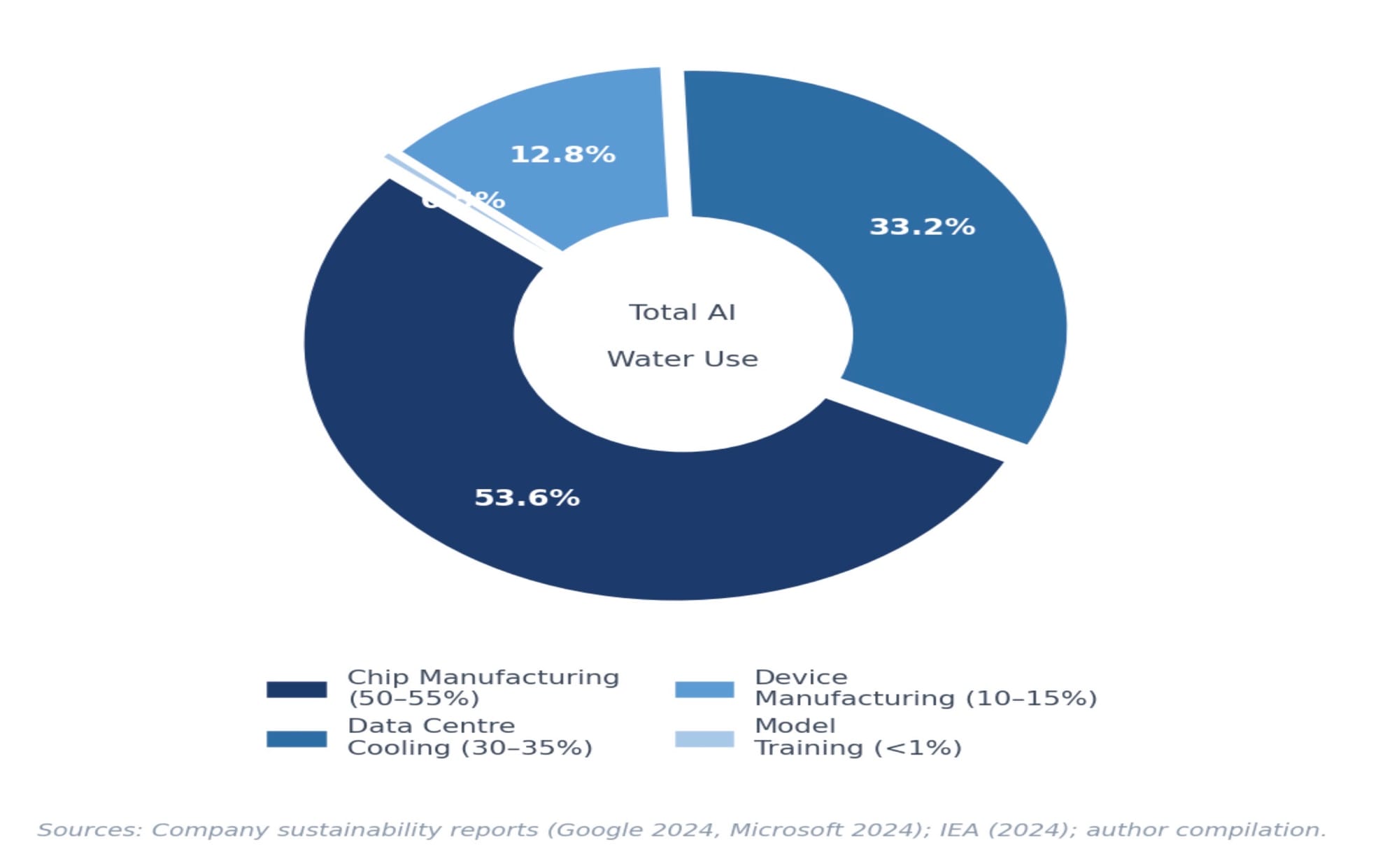
· Where Water Goes: Chip making uses the most (50%-55%), followed by data center cooling (30%-35%), and making devices (10%-15%). Training models use less than 1% of the total water, though they consume a lot of water per task.
· Water Efficiency (WUE): The WUE score (water use per unit of energy) dropped from 0.49 L/kWh in 2021 to 0.30 L/kWh in 2024. Top companies like Microsoft are 30% to 40% more efficient than the rest of the industry.
Growth in Total Amounts(Trends for 2025-2030)
· Chip Making: As more chips are made, water use will reach 20 to 23 billion cubic meters by 2030. However, as companies use more recycled water (reused water), the need for fresh water will grow more slowly.
· Data Centres: By 2030, total cooling water use will reach 18 to 22 billion cubic meters. But as machines improve, the water required per unit of computing power will drop by 40% to 45%.
· Model Training: As models get bigger, training one model might need up to 2 million litres of water by 2030. The total water for training will grow very fast, about 55% to 60% each year.
Better Technology(Trends for 2025-2030)
· New Cooling Ways: By 2030, 80% of new data centres will use liquid cooling (water-saving cooling). This technology helps them lose almost zero water to the air.
· Water Recycling: By 2030, more than 50% of the water in the chip industry will be recycled. Many data centres will also have systems to collect rain and reuse wastewater.
Core Summary
· Main Features: Today, the "carbon footprint" (total gas produced) of the AI industry is already as big as a medium-sized country. It produces about 500 to 600 million tons of CO2e and uses 25 to 30 billion cubic meters of water every year. Making chips and running data centres are the two most important parts, as they use the most power and water.
· Growth Trends: Between 2025 and 2030, the total amount of carbon and water used will keep growing. Carbon will grow by 4% to 15% each year, and water will grow by 3% to 6%. However, for each unit of computing power, the cost to nature is dropping fast. Carbon use will drop by 30% to 50%, and water use by 40% to 45%. This means better technology is helping to reduce the pressure from growing so big.
· Key Factors: Four main things will change the future. These include using more green energy (solar or wind power), using liquid cooling (advanced cooling technology), reusing water (recycled water), and making AI models smaller (model optimisation). The technology choices made by top companies will set the pace for the entire industry to become "green."
References
· ISO 14067:2018. Greenhouse gases — Carbon footprint of products. International Organization for Standardization.
· ISO 14046:2014. Environmental management — Water footprint — Principles, requirements and guidelines. International Organization for Standardization.
· ISO 14064. Greenhouse gas quantification and reporting.
· Google (2024). 2024 Environmental Report.
· Microsoft (2024). Environmental Sustainability Report 2024.
· IEA (International Energy Agency). Electricity 2024: Analysis and forecast to 2026.
· Patterson, D., et al. (2021). Carbon Emissions and Large Neural Network Training.
· Meta AI (2024). The Llama 3 Herd of Models.
· TSMC (2022). Sustainability Report.